

E
Using OEE Effectively – Part 2: Complete Loss Data Is the Basis for Meaningful OEE Analysis
Using OEE Effectively – Part 2:
Complete Loss Data Is the Basis for Meaningful OEE Analysis
Part 1 Using OEE Effectively – Part 1: Why the Highest Value Is Not Automatically the Best explained that OEE is only meaningful and comparable when clear calculation rules apply. Yet even the best OEE standard is of little value if some losses are not captured at all. What is not known can neither be assessed nor improved.
MajorDowntime Is Obvious – Many Small Losses Are Not
Before we introduce digital data acquisition for new customers, some machines often already have a basic manual method for recording downtime. This generally documents and discusses the major events in particular.
Everyone therefore remembers the tool breakage last week that cost three and a half hours of production time. Far less visible are the many short interruptions: five minutes waiting for material, ten minutes without an available operator or a recurring sensor fault.
If a machine stops five times for just ten minutes on each of six production days, this already adds up to five hours of loss time per week. The many small interruptions therefore outweigh the single tool breakage – particularly if that breakage occurs only once every six months.
What is more, recurring organizational or logistical losses can often be reduced comparatively easily. The prerequisite is that they become fully visible.
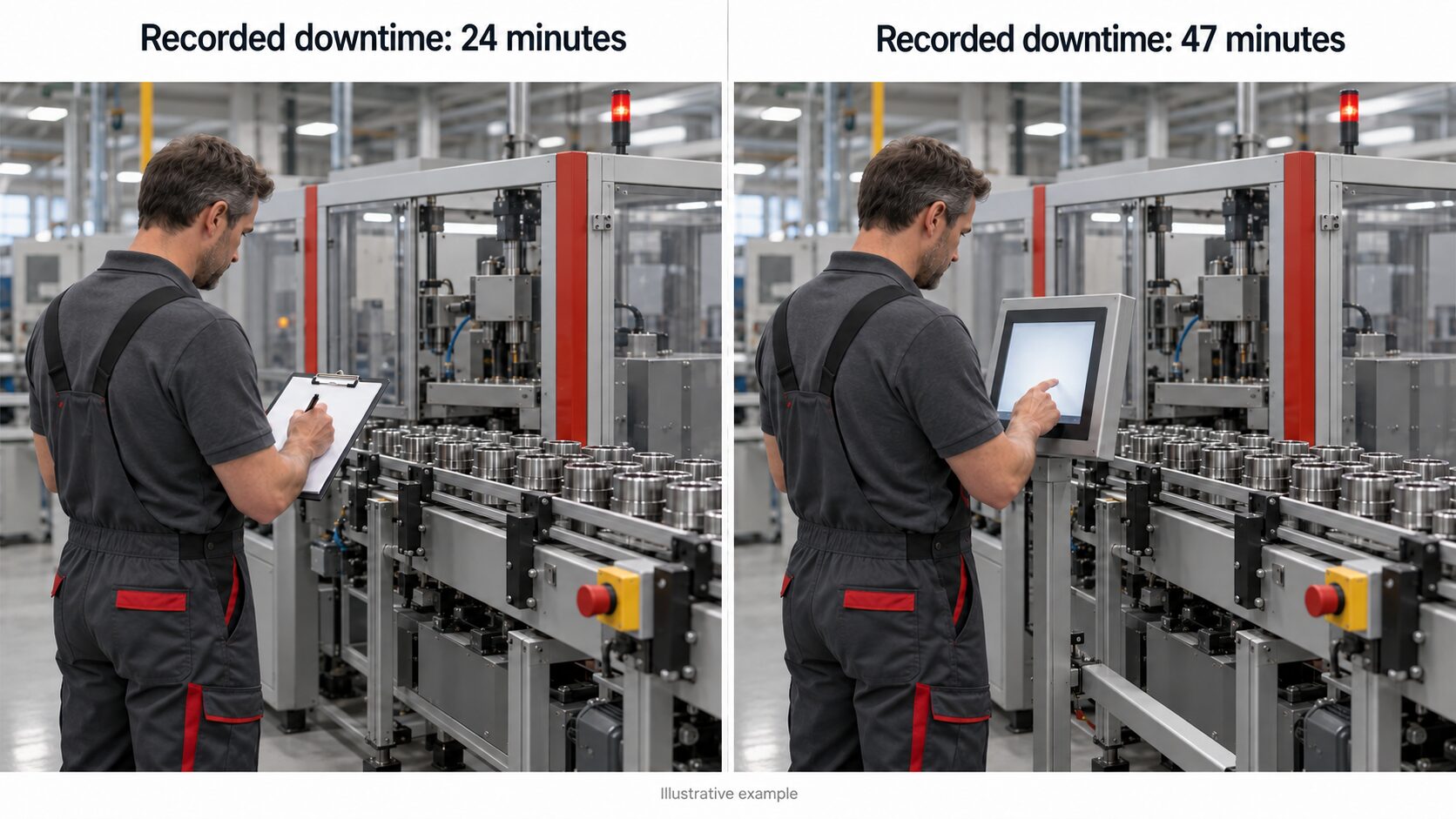
Fig.: Same machine, same shift: With rudimentary data acquisition, some downtime is not captured. Cosmino, by contrast, provides complete transparency. (AI-generated illustration)
The Blind Spot Is Often Larger Than Expected
In projects with new customers, we regularly find that a substantial share of the actual loss time was previously unknown. After automated data acquisition is introduced, the actual loss time can be up to 50 percent higher than the customer had assumed. At the same time, loss causes emerge that the company had not anticipated.
This blind spot should not be accepted, even when production appears to be running well overall. A company should know where and why production capacity is being lost. As one customer aptly put it: “Without Cosmino, we would be flying blind.”
Transparency is especially valuable in challenging economic conditions. Companies that know their losses precisely understand where they can improve production and release additional capacity. The data also helps them make better-founded assessments of actual capacity requirements and the profitability of individual products.
This is not limited to complete downtimes. Comprehensive data acquisition also reveals other deviations:
- Cycle-time deviations: At the beginning of many projects, we measure deviations of up to 30 percent between target and actual cycle times. As a result, products or orders may be less profitable than assumed. Conversely, the data also identifies products that are manufactured faster than calculated and may therefore open up additional market opportunities
- Setup times: The target values stored in the master data do not always reflect reality. Only systematic capture reveals how much setup times vary and for which products, machines or shifts improvements are possible.
- Other activities: Rework, maintenance, training and prototype production are often not allocated clearly in terms of time. As a result, the effort is missing from the relevant order or cost center and is treated inconsistently in OEE.
A complete timeline therefore provides the basis for reliable OEE. Production time, breaks, setup processes, faults and other relevant states must be represented completely and transparently.
Capturing Even the Smallest Time Losses Without Overburdening Operators
Time losses lasting only a few seconds present a particular challenge. A machine may stop briefly again and again, or each production cycle may take slightly longer than planned. Each individual deviation appears insignificant and is often too short to be assigned a cause manually as it occurs. Across many cycles and an entire shift, however, these deviations can add up to substantial losses.
These deviations often have a recurring cause: The specified cycle time does not reflect the production time that can actually be achieved, the material is temporarily more difficult to process or a new employee is not yet fully familiar with the process.
Cosmino ensures that these short periods of lost time are not overlooked: They are captured automatically as micro-stops and included in the analysis. The system can also define the duration from which an operator must assign a specific loss reason to a downtime.
To avoid burdening employees with classifying every single short event, micro-stops can be classified collectively at the end of the shift. A selected number of micro-stops, or the resulting loss time, can then be assigned to a loss reason. This is particularly useful when the short losses are mainly attributable to one or a few recurring causes.
In addition to short interruptions, Cosmino also considers deviations from the target cycle time. If the cycle time systematically deviates from the target over an extended period, the operator can record and explain a performance deviation directly in the data entry dialog. The deviation is then shown accordingly in reporting. No additional micro-stops are generated for the period concerned, because the slower or faster production and its cause have already been documented. This keeps the deviation transparent without counting it twice.
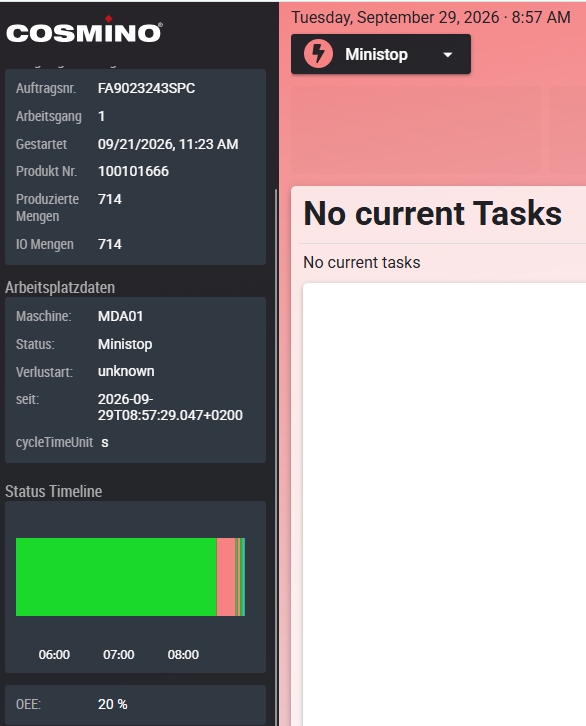
Fig.: Micro-stop acquisition in the Cosmino dialog: The machine status display highlights an as-yet-unclassified period of lost time in pink. However, a data collection task is only triggered if this period exceeds a configurable threshold. Otherwise, the loss is automatically recorded as a micro-stop.
Interpreting Machine Signals Correctly
Importing machine data automatically is a crucial step toward complete OEE. However, the signals supplied cannot always be translated directly into states, quantities or losses.
Sometimes only a combination of several signals provides an unambiguous machine state. In other cases, rules are needed to determine whether quantity signals during setup should be counted, or whether quantities transmitted during maintenance are implausible and should therefore be excluded. Machine counters that reset to zero at midnight must also be processed by the MES in a way that continues the total quantity correctly.
Cosmino is therefore configured to interpret and combine the automatically imported signals correctly. The captured data is also checked for plausibility:
- Are there unexplained periods or overlaps?
- Are the recorded machine states consistent?
- Are operating times and production quantities plausible?
- Have events and quantities been assigned to the correct states?
- Are counter jumps or resets processed correctly?
Reliable production data can only be generated from signals that are acquired technically and interpreted correctly from a technical perspective.
The Machine Detects the Event – the User Knows the Cause
Not all causes of loss can be derived directly from machine signals. The machine may detect that it has stopped or is producing more slowly. In some cases, it also supplies more specific information, such as a material shortage or a fault reported by a component. Yet this often describes only the symptom – not the actual reason why the material is missing or why the defect occurred.
When the machine signals do not provide an unambiguous loss cause, the machine operator records it manually. This is based on an individually configurable loss reason catalog containing only the causes relevant to the respective machine or workstation
The system can also define which additional details are required. For example, in addition to the loss reason, users can select a specific loss location within the machine or enter supplementary free text.
Combining automated acquisition with human assessment is essential: The MES ensures that no downtime is missed. The user adds the knowledge that cannot be obtained from the machine signals alone.
Complete Data Provides the Foundation for Improvement
OEE becomes reliable only when data acquisition contains no relevant gaps. It reveals not only the known major downtime events, but also recurring micro-stops, cycle-time deviations, unscheduled activities and previously unknown causes of loss.
The total duration of a loss is not the only decisive factor. Its frequency and the average time between two events with the same cause also provide important clues. A rare event with a long duration requires different action from a short disruption that occurs dozens of times every day.
Complete and correctly interpreted data shows where production time is actually being lost – and where improvements are particularly worthwhile.
The next part of our “Using OEE Effectively” series explains how reliable data can be turned into concrete improvements – and how an MES can support the improvement process beyond measurement alone.
Using OEE Effectively – Part 3: Turning Loss Analysis into Measurable OEE Improvement
An OEE value on a dashboard does not improve production by itself. Part 3 looks at how to prioritize losses correctly, shorten response times, implement actions and verify their success using production data zu überprüfen.
Using OEE Effectively – Part 1: Why the Highest Value Is Not Automatically the Best
How should breaks, setup times or multi-day downtimes be handled? Part 1 explains why the familiar OEE formula alone is not enough and why clear, consistent calculation rules are essential for meaningful comparisons.