
| Deutsch
+49 (0)911/462676-0 | info@cosmino.de
 

Using OEE Effectively – Part 1: Why the Highest Value Is Not Automatically the Best

Using OEE Effektively – Part 1:

Why the Highest Value ist Not Automatically the Best

Many companies use OEE to assess the performance of their equipment and therefore aim to achieve the highest possible value. Yet machines operate under different conditions: product mix, batch sizes, setup frequency, level of automation and machine age all influence the result. At the same time, the OEE calculation itself allows considerable scope for interpretation. A low OEE is therefore not automatically a poor OEE – what matters is what lies behind the value.

The Same Downtime, a Different OEE

As an MES provider, we have extensive experience in the acquisition and analysis of OEE data across numerous projects. MES functions provide the technical foundation, but at first they are only a tool. To produce meaningful results, that tool must be configured to match the company’s operational requirements and agreed calculation rules.

That is why, at the start of an OEE project, we first clarify how the company calculates OEE and which rules apply. Typical situations from production quickly show why this clarification is necessary:

A machine breaks down during an active shift. The required spare part will not be available for another three days, even though the machine was scheduled for the entire period. Should all downtime hours be counted as loss time? Or only the first day, because the machine is then removed from the production schedule? Some companies do not classify the outage as a loss at all if the order can be moved to another machine.

Another typical case: A machine is down because of a fault from 10:05 to 10:35 a.m. However, the regular break started at 10:00 a.m., so the operator cannot respond immediately. Should the entire half hour be counted as unplanned downtime, or should the break be excluded from the loss time?

The actual course of production is clear in both cases. Depending on the agreed rules, however, it can still result in different OEE values. The formula alone does not answer these questions – they must be clarified from a business and production perspective and defined as binding for everyone involved.

Fig..: Due to the break, the machine failure is not addressed immediately (AI-generated illustration)

Transparent Rules Create Reliable OEE

From a strictly methodological perspective, actual losses should be included in OEE as completely as possible. In operational practice, however, we encounter different definitions and objectives.

For example, a company may decide that scheduled machine maintenance should not be included in the OEE calculation. Cosmino therefore allows such activities to be defined as planned downtime in the master data and excluded from the calculation accordingly.

For us, the decisive point is not whether every individual rule follows the supposedly “purest” interpretation of OEE. What matters is that the rule is chosen deliberately, documented transparently and applied consistently across all comparable machines and workstations.

An OEE of 60 percent that consistently reveals loss time may be more valuable for improving production than an OEE of 80 percent that excludes relevant downtime. The goal should therefore not be limited to achieving the highest possible value. It should be to identify losses, understand their causes and improve OEE sustainably.

A Common Standard for Calculation and Data Acquisition

A company-wide OEE standard defines:

  • which time periods are included in the calculation,
  • how breaks, setup times, and planned downtimes are handled,
  • when unplanned downtime starts and ends,
  • how performance and quality losses are evaluated,
  • and how extended downtime or subsequent rescheduling is handled.

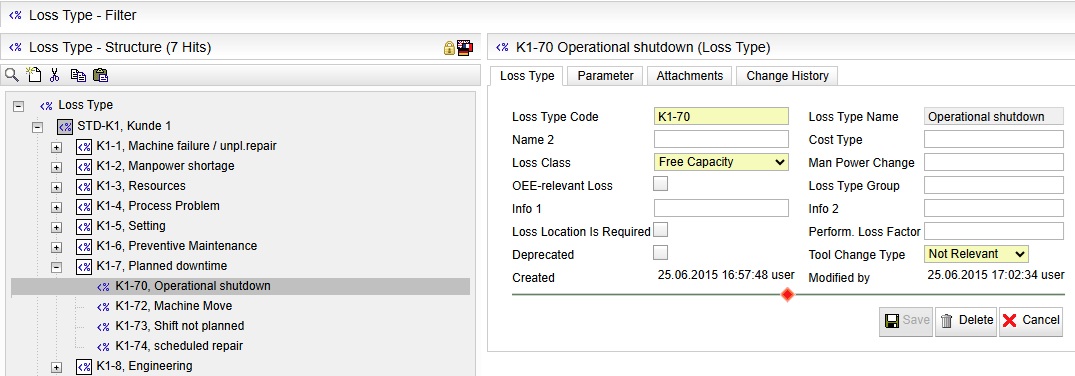
A consistent loss type catalog is equally important. It should be detailed enough to distinguish and analyze relevant causes, while remaining concise enough for production employees to select the correct reason quickly and unambiguously.

This is a key part of our contribution to OEE projects: We ask the questions that will later determine how meaningful the KPI is, contribute our experience from a wide range of production environments and then map the jointly agreed methodology in Cosmino Panteo.

Fig.: The loss categories relevant to OEE analysis can be individually structured in the master data and assigned to specific machines. By using common groups, the results remain comparable even when not all machines use the same loss types.

When Plants and Machines Can Truly Be Compared

A practical example shows how far companies can take a common OEE standard: Based on consistent definitions, one customer has established reliable comparability across several plants. In this case, helpful prerequisites include similar products for the respective local markets and the widespread use of the same machine types.

Even there, however, only machines that manufacture comparable products under conditions that are as similar as possible are compared directly. And even machines of the same model can produce different results because of their age and technical condition.

Learning From Each Other Instead of Just Comparing Values

What always works – and is also practiced by the customer in this example – is sharing successful improvements. Which action reduced a particular loss? Why do short stoppages occur less frequently on a comparable machine? How did one plant improve its setup times or scrap rate?

These findings should be documented and made available to other departments and plants. For management, the development of the KPI should therefore be more interesting than a simple comparison between two OEE values: Which area is succeeding in reducing its losses sustainably, and how was this achieved?

This turns OEE from a mere performance metric into a powerful tool for continuous improvement. Clear calculation rules, a practical loss type catalog and a shared data basis are essential to this approach work.

What matters is not the OEE level itself, but that it is based on clear rules and provides visibility into the right areas for improvement.

The next part explains why even the best OEE standard is of little value if the underlying data is incomplete or incorrect – and why short disruptions can lead to significant hidden losses.

Using OEE Effectively – Part 2: Complete Loss Data Is The Basis for Meaningful OEE Analysis

Major downtime events are obvious. Short interruptions, cycle-time deviations and activities that are not clearly allocated often remain hidden. Part 2 explains how losses can be captured and assessed completely while keeping the process practical.

Using OEE Effectively – Part 3: Turning Loss Analysis into Measurable OEE Improvement

An OEE value on a dashboard does not improve production by itself. Part 3 looks at how to prioritize losses correctly, shorten response times, implement actions and verify their success using production data zu überprüfen.

COSMINO AG 19 Bewertungen auf ProvenExpert.com